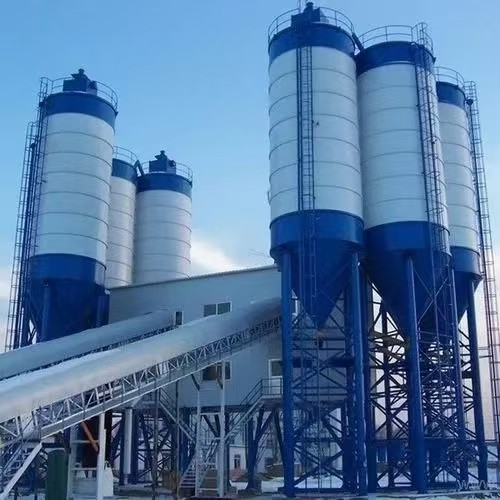
Entering any large-scale construction site, a concrete mixing plant is an indispensable core equipment. This behemoth, known as the "Flowing Blood Factory," appears rugged but is actually a precision system that integrates mechanical, electronic, and materials science. It mainly consists of five core components that form a closed-loop production chain:
Mixing host: As the "heart", the double horizontal shaft forced mixer runs at a high speed of 30 revolutions per minute. The mixing blades are made of tungsten carbide alloy material, with a service life of up to 4 times that of traditional alloys. It can fully mix sand, cement, water, and additives, ensuring that the uniformity error of each concrete does not exceed 5%.
Precision measurement system: Like a "balance steward", it uses high-precision sensors and PLC control system to achieve gram level weighing of raw materials such as cement and aggregates, with an error controlled within ± 1% - this means that the deviation of 10 cubic meters of concrete batching does not exceed the amount of one barrel of mineral water, directly determining the strength of the engineering structure.
Fully enclosed conveying network: Aggregates are conveyed by sealed belt conveyors, while cement is transported by pneumatic conveying systems, ensuring no dust leakage throughout the entire process. A three-star mixing plant in Chongqing has adopted an automatic feeding and control system to achieve unmanned transportation of raw materials from warehouse to machine, increasing efficiency by more than 15%.
Intelligent control system: It can be called the "brain center". Operators can set production parameters through the touch screen. The system can automatically adapt to environmental temperature and humidity to adjust the water cement ratio. It can also monitor equipment speed, current and other data in real time. The fault warning response time does not exceed 3 seconds.
Environmental protection treatment unit: dust removal, noise reduction, and wastewater recovery equipment operate synchronously. The pulse dust collector can capture 99.97% of the dust, and the three-stage sedimentation tank enables the recycling rate of car wash wastewater to reach 90%, completely bidding farewell to the image of traditional mixing plants as "gray headed and dirt faced".
Its workflow may seem simple, but there are hidden mysteries: first, the material storage system prepares the materials, then the metering system accurately mixes them according to the ratio, transports them to the mixing host for mixing for 60-90 seconds, and finally transports them to the construction site through a mixer truck or pump. The entire process is automated and controlled, and can produce up to 360 cubic meters of concrete per hour, which is equivalent to the manual mixing volume of 30 workers per day.